Skip to content
DynesGarage Door ExpertsOpen 24/7 (289) 816-2884
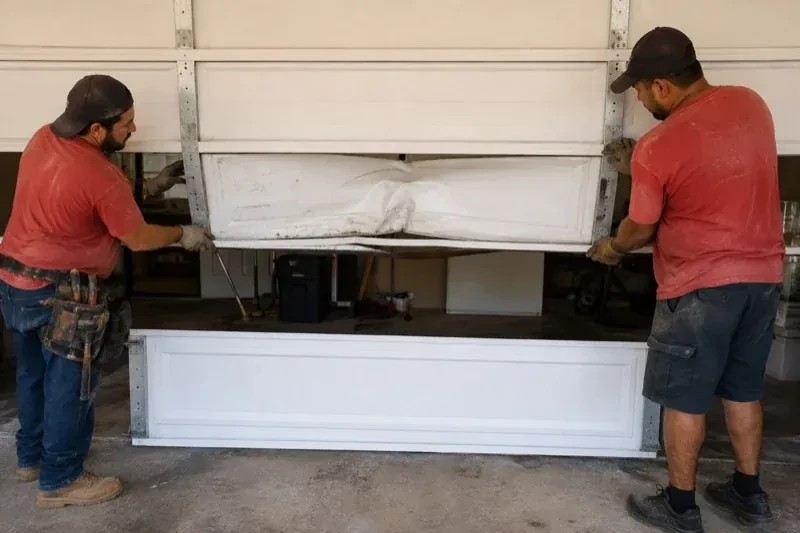
Two people holding a dented lower garage-door section above a separate white panel resting on the ground. — Garage Door Panel Replacement, Dynes

Repairs · Dynes

Garage Door Panel Replacement

The inside face of one section has started to bow outward and the outer skin has a soft, wavy look. Tap it and it sounds hollow in places.

In plain words

Winter is hard on the bottom section. Meltwater collects under the seal and freezes the door to the slab; the opener then pulls on a door that is anchored at the floor, and the bottom section bows or a hinge tears out of its stile. Road salt and slush finish the job by rusting the lower edge. Replacing that section restores a flat, sealed bottom edge and gives the door a new set of bottom brackets and seal retainer. Because the lift cables attach at the bottom, the springs are unloaded first, then reloaded and balanced once the new section is in, so the door runs as it should.

Sound familiar?Dynes

The call
Rust has crept along the bottom edge of the lowest section. What began as bubbling paint is now a soft, flaking strip, the seal retainer is working loose, and a screwdriver pressed against the worst spot goes through the steel.
NextHow the visit goes

Garage Door Panel Replacement · Dynes

How the visit goes

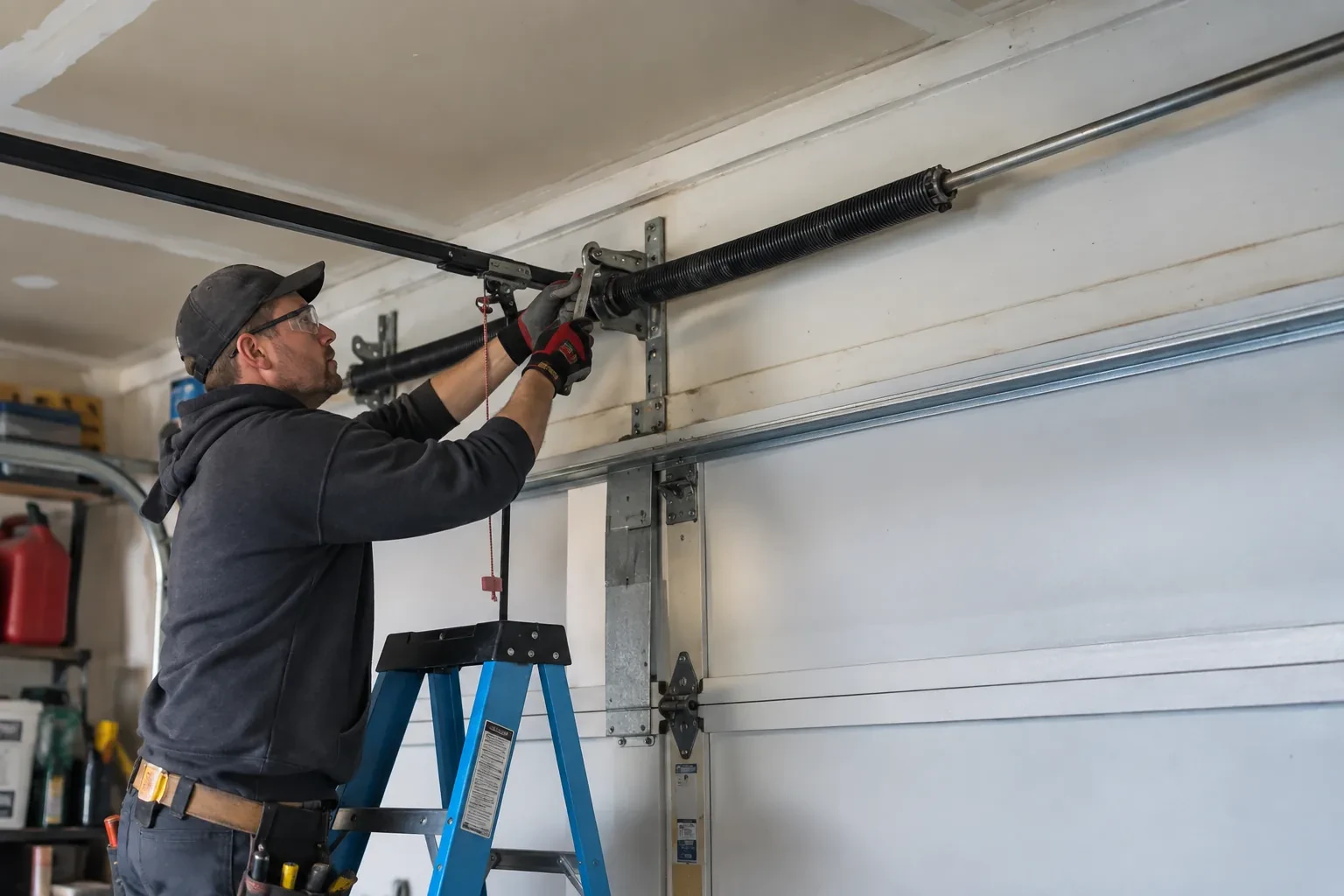
Technician on a blue ladder holding a wrench at a coiled torsion spring above a white garage door. — Dynes
  1. Scene 1

    Mapping the damage on the section

    Where a dent sits matters as much as its size. A shallow dish in the middle of the skin is one thing; a crease that runs to the joint, a fold at an end stile, or a bend through a hinge point is another, because those areas carry the door's load as it moves. The technician records the depth of the damage, whether the inner skin or backer is affected, whether a strut has kinked and whether the section still lies flat when the door is closed. That map decides between working the dent out, replacing the single section, or looking harder at the rest of the door.

  2. Scene 2

    Bottom section: brackets, seal and cables

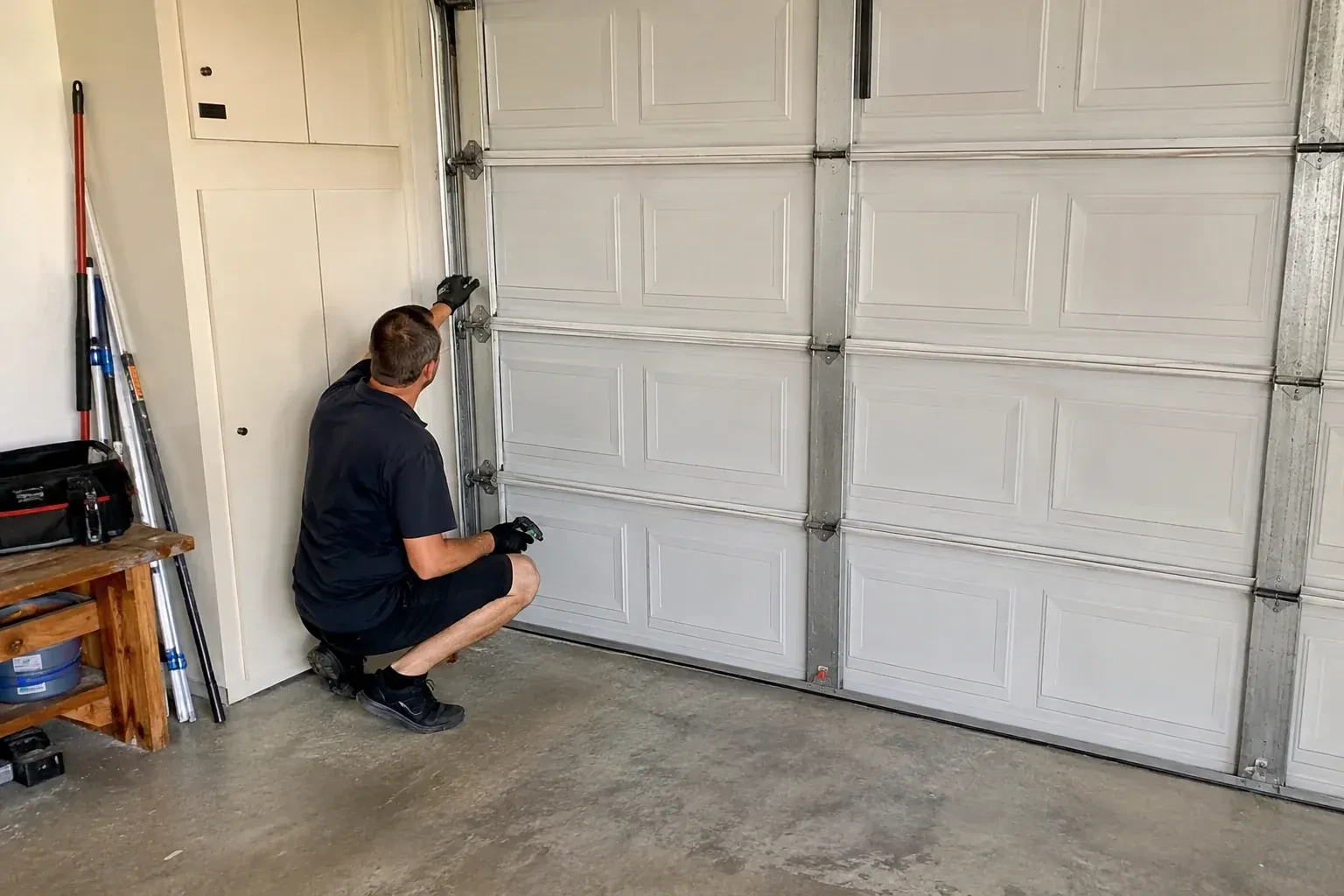
    A new bottom section arrives bare, so its working parts are fitted on site. Bottom brackets are bolted to each end, with the cable attached and the safety tab in place, and a roller set in each bracket. The seal retainer is fixed along the bottom edge and a new astragal is slid into it so the door meets the floor evenly. The lift cables are laid over the drums, the springs are wound back to the correct number of turns for the door's height, and the set screws are tightened. The door is then eased off the floor by hand to confirm the cables are seated and even on both sides.

  3. Scene 3

    A door that runs as one piece again

    When the work is finished the new section is indistinguishable in the way the door moves. The joints close tight with no daylight, the door rises without the shudder or catch that gave the damage away, and it sits level on the floor with the seal compressed evenly across its width. The technician walks you through the cycle with the opener and by hand so you can see the balance for yourself, points out the hinges and rollers that were replaced, and leaves the old section for disposal or takes it away as you prefer. Any temporary bracing from the first visit is gone.

In the van

  • Winding bars and track clamps
  • Bottom seal retainer and astragal
  • Numbered section hinges
  • Self-tapping stile screws
  • Nylon or steel rollers

What shapes the quoteDynes Garage Door Experts

Condition of tracks and cables
An impact often nudges a track bracket or nicks a cable where it wraps the drum. Straightening or resetting track and replacing a cable are itemised so the section quote stays clear.
Door width and section size
A section for a double door is nearly twice the length of one for a single door, with more steel, more hinges and a heavier lift. Section height and thickness feed into the same line.
Spring work required
A bottom section means torsion springs are unwound and rewound, or, on an extension-spring door, the door is raised and secured so the springs relax and its hooks and cables are reset instead. A section changing the door's weight may call for a balance adjustment.

FeesSame any hour

Have it ready

Before you call · 0 / 3

(289) 816-2884

The questions that come up

Do the hinges and rollers get replaced at the same time?

Hinges and rollers that are bent, cracked or worn are replaced with the section, and the technician checks each one on the affected joints. Sound hinges can be transferred, always by their stamped number, since each position in the door uses a different offset. Rollers that have flat spots, wobbly stems or dried bearings are swapped, often for nylon rollers that run quietly. Fasteners are always new, driven into fresh holes in the new stiles.

What happens to the opener during the work?

It is disconnected at the release cord and unplugged before any hardware comes off, so the motor cannot pull on a door that is missing a section. After the new section is in and the door has been balanced by hand, the opener is reconnected and tested: its reversal against a board on the floor and its photo-eyes are checked every time, and the open and close limits or the force setting are reset only if that check shows they need it.

How do I know whether the damage is only cosmetic?

Watch the door move. A cosmetic dent leaves the section flat at the joints, the door travelling without a catch, and the hinges and rollers seated normally. Signs that the damage goes further include a crease that reaches a joint or stile, a hinge screw that has pulled out, a roller sitting crooked in the track, a gap of daylight at a joint, or a shudder as that section reaches the track curve. Any of those calls for a proper assessment.

Dynesinformation

HaltonOntario

Town
Dynes, Halton
In business
19 years
Hours
Open 24/7
Nights, weekends and holidays, same fees
Visits
On-site assessment preferred. Request a visit or call.

2021 census: what it means at the door

Every square is one home in a hundred.

  • 47 in 100 homes · mixed ages
  • About 47% of homes in Burlington were built in 1980 or earlier, according to the 2021 Census.In areas with a spread of building periods, garage doors fail for different reasons on the same street: worn pulleys and stretched cables on the older doors, cycle-limit springs and tired opener gears on the newer ones. Knowing which pattern applies shortens the diagnosis.
  • Single-detached houses make up about 50% of homes in Burlington (2021 Census).Mixed housing often means mixed access too: individual remotes and keypads on the houses, building fobs and shared gates on the condos. We program, clear and replace all of these, and keep property managers in the loop where a door serves more than one household.

Source: Statistics Canada, Census Profile

Open Dynes in Google Maps

On-site assessment

Request a visit.

The inside face of one section has started to bow outward and the outer skin has a soft, wavy look.

(289) 816-2884, open 24/7.