Skip to content
DynesGarage Door ExpertsOpen 24/7 (289) 816-2884
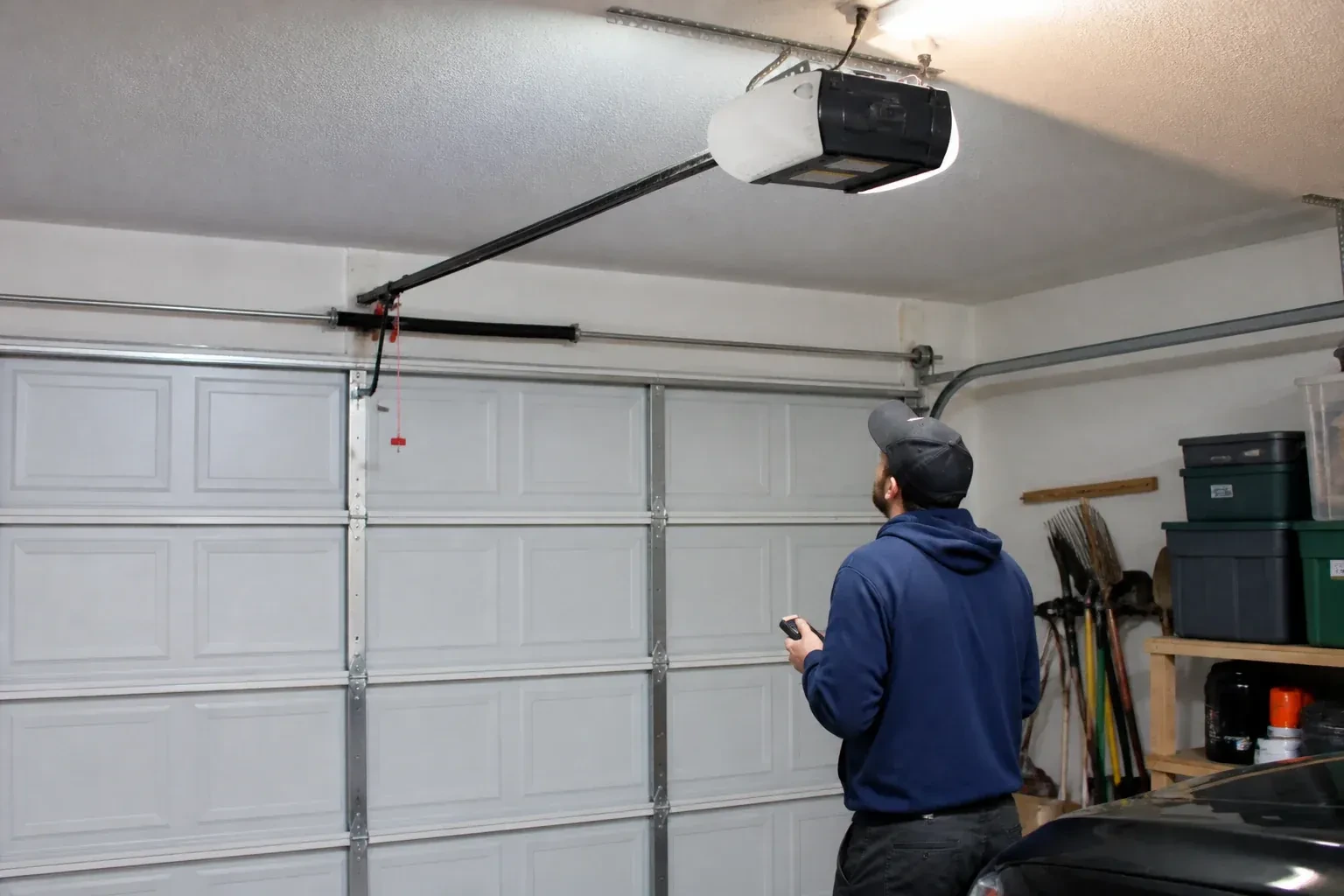
A person holding a remote looks toward an overhead garage-door opener and rail. — Garage Door Opener Diagnosis and Repair, Burlington

Openers · Burlington

Garage Door Opener Diagnosis and Repair

Nothing. No light, no click, no hum from the unit on the ceiling.

In plain words

Every diagnosis ends with the same two tests, because an opener that moves the door is only half fixed. First, a length of 2x4 is laid flat on the floor under the centre of the door and the door is closed onto it; it must reverse on contact and return to fully open. Second, with the door closing, an object is passed through the photo-eye beam near the floor; the door must stop and reverse. These tests are how the opener standard defines a working unit, and they are how the technician proves that the fault found was the fault fixed.

Sound familiar?Burlington

The call
The motor runs, the chain rattles along the rail, and the door does not move a millimetre. You notice the little carriage sliding back and forth on its own. Last week the power was out and someone pulled the red cord to get the car out.
NextHow the visit goes

Garage Door Opener Diagnosis and Repair · Burlington

How the visit goes

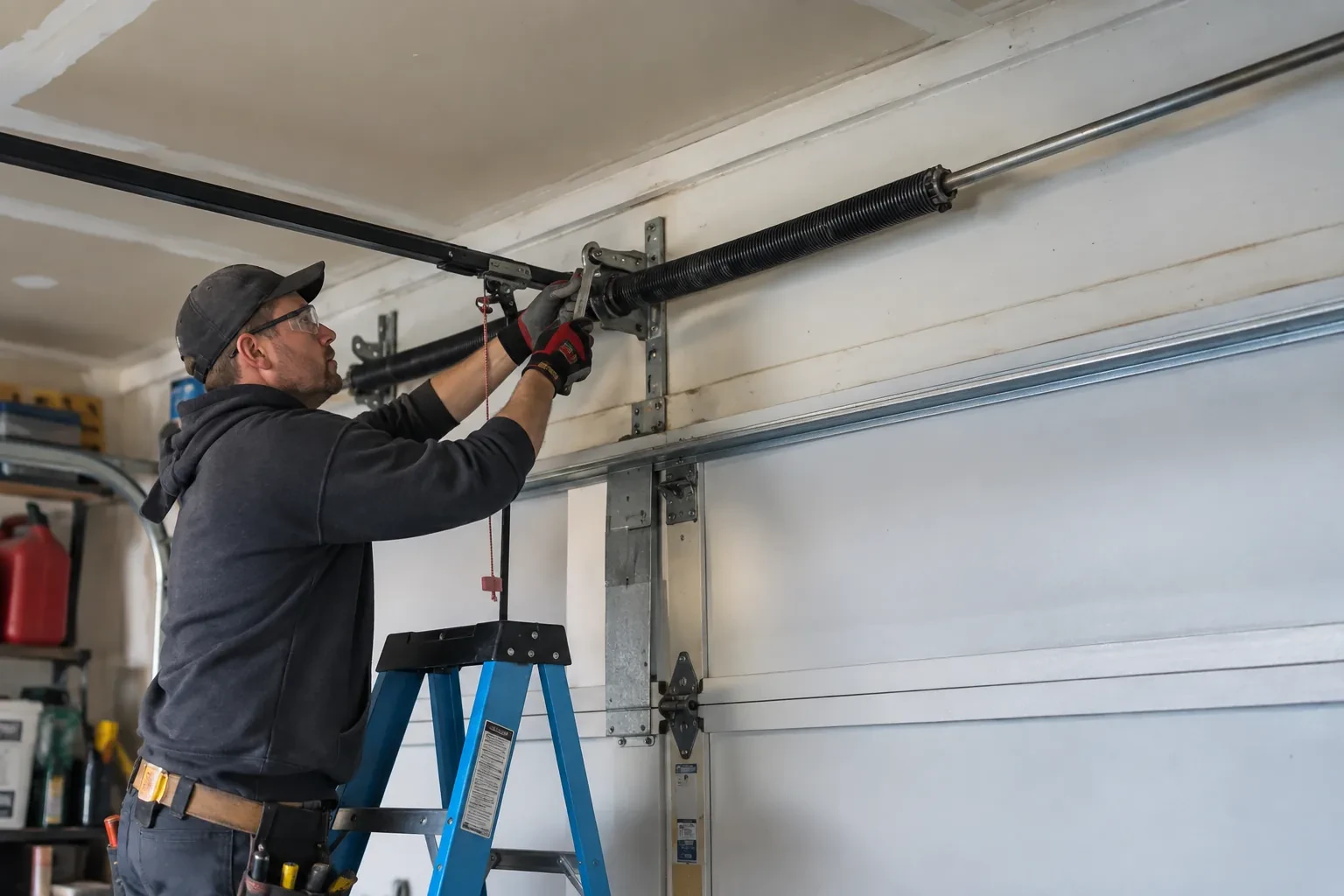
Technician on a blue ladder holding a wrench at a coiled torsion spring above a white garage door.
  1. Scene 1

    The story before the tools

    Diagnosis begins with what you saw and heard. When did the door last behave, and what changed between then and now: a power outage, a storm, a new light bulb, a shovel leaning against the sensor, someone pulling the red cord? Does the motor hum, click, run or stay silent? Does the fault follow one control or all of them? Is the door stranded up or stranded down, and does it move at all by hand? A few minutes of this on the phone or at the door points the technician at one part of the system instead of all of it, and often shortens the visit considerably.

  2. Scene 2

    Re-engaging or rebuilding the drive

    A trolley that was disconnected by the release cord is re-engaged: the door is placed by hand, the carriage is run to meet it, and the two latch together with an audible click. A stripped drive gear, the classic failure on chain-drive heads, is replaced as a kit: cover off, motor lifted, worn gear and sprocket out, new gear, sprocket, bushings and grease in, chain re-tensioned so it sags only slightly below the rail. A snapped or badly stretched chain or a frayed belt is replaced and tensioned. Each repair ends with a full open-and-close cycle while the technician watches the trolley for smooth, even travel.

  3. Scene 3

    Knowing the red handle

    The red cord hanging from the rail is the emergency release, and you now know how to use it properly. Pull it only when the door is closed, so a door that turns out to be unbalanced has nowhere to fall. The door then lifts by hand, useful during an outage. To reconnect, most units re-latch when the opener is run and the trolley meets the carriage, or when the door is lifted until it clicks. The handle should hang no higher than about 1.8 metres and clear of the car. If the door feels heavy when released, that is a spring message, not a test of strength.

In the van

  • Travel limit switch or RPM sensor
  • Garage door lubricant
  • Logic board or receiver
  • Photo-eye sensor pair
  • Remote batteries (coin and cylinder cells)

What shapes the quoteDynes Garage Door Experts

Condition of the mounting
A rail that has sagged, a header bracket pulling out of the wall, or ceiling angle iron that has loosened must be re-secured before the opener is set up, and that hardware work is itemized.
Time of the call
A weekday daytime visit and an evening, weekend or holiday call cost the same amount for an opener diagnosis. The technician confirms the exact figure once the drive, the sensors and the wiring have been checked in person.
Sensor realignment versus replacement
Straightening a bracket and cleaning a lens is a small task. Replacing the sensor pair and running new wire along the wall and ceiling is a larger one, and the quote names which applies.

FeesSame any hour

Have it ready

Before you call · 0 / 3

(289) 816-2884

The questions that come up

What should I check before calling?

Look for the simple things: is the opener plugged in and its light working, has the wall control's lock indicator started blinking, does another remote work, is anything sitting in the path of the sensors, and are the little sensor lights steady. Note what the motor does when you press a button. Do not try to lift a door that is stuck if a spring looks broken. Whatever you find, tell the technician; it shortens the diagnosis.

The door is stuck shut and my car is inside. How do you get in?

Through the house if the garage connects to it, or through a side door. Many doors also have an outside keyed emergency release, a small keyed cylinder that pulls the trolley free so the door lifts by hand from outside. If yours does not have one, the technician can fit a keyed release kit as part of the visit so there is a safe way in next time; until then, an alternate entrance is used and the diagnosis proceeds once inside.

Why does my garage door open by itself?

A door that opens with nobody pressing anything is usually being told to by a fault in its wiring or a control. A pinched or stapled wire to the wall control can short intermittently and act like a button press; a stuck button on a remote left in a coat pocket does the same; and a neighbour's remote on an old fixed-code opener can occasionally trigger it. The technician isolates each control in turn until the phantom command stops.

Burlingtoninformation

HaltonOntario

Garage Door Opener Diagnosis and Repair · Dynes, Elizabeth Gardens, Longmoor, Orchard, Port Nelson, Roseland, Strathcona Gardens

Town
Burlington, Halton
In business
19 years
Hours
Open 24/7
Nights, weekends and holidays, same fees
Visits
On-site assessment preferred. Request a visit or call.

2021 census: what it means at the door

Every square is one home in a hundred.

  • 47 in 100 homes · mixed ages
  • About 47% of homes in Burlington were built in 1980 or earlier, according to the 2021 Census.A mixed-age neighbourhood is where retrofits are most common: safety cables added to extension springs, a torsion conversion on an older door, insulated panels replacing a hollow door, or a quieter belt opener under a newly finished room above the garage. Each is a routine job for us.
  • Single-detached houses make up about 50% of homes in Burlington (2021 Census).Where houses and attached homes sit together, the shared garage door on a small condo building may be a commercial operator on a heavy door, while the house next door runs a light residential unit. We service both types and carry parts for each.

Source: Statistics Canada, Census Profile

Open Burlington in Google Maps

On-site assessment

Request a visit.

Nothing.

(289) 816-2884, open 24/7.